Helical shaft — picking the one tooth that defines the other thirty
On a worn helical shaft, every tooth tells a slightly different story. Choose the wrong master and the error compounds along the whole spiral. Here is how we found the golden one.
The problem
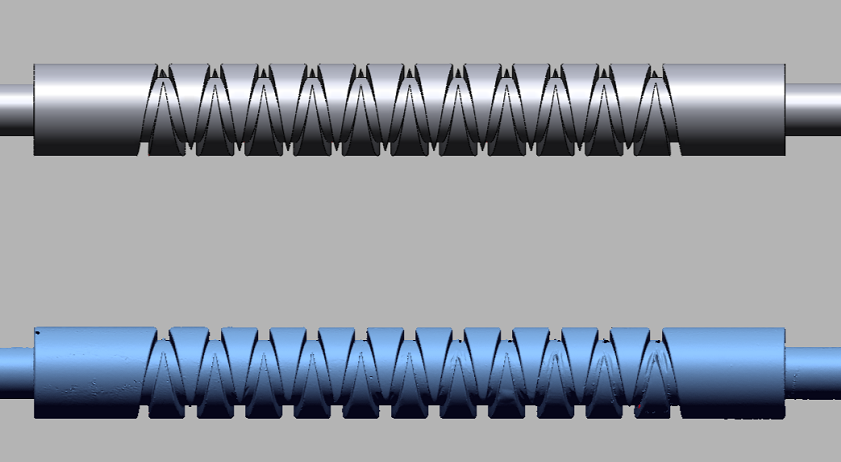
The client expected the spiral to be the hard part. The real risk was elsewhere: every tooth on the scan had a different wear pattern, and the entire helical pattern would inherit whatever profile we picked as the master. A poor choice would multiply the defect thirty-plus times along the shaft.
Our approach
- 1Decimated the raw mesh at 0.15 mm to kill scan noise without losing tooth detail
- 2Ran a face-by-face deviation map in Design X to find the statistically cleanest tooth profile
- 3Locked that 'golden tooth' as the master feature; suppressed every other tooth until it matched
- 4Sanity-checked the master with a ±20 µm offset re-run — both offsets had to spike the error map before we trusted it
- 5LiveTransfer to SolidWorks for a watertight parametric tree, then an interference check inside the mating housing
The result
The whole helical pattern propagated cleanly from a single, validated master — green-lit for CAM and simulation with no rework cycles. The QA artefact (master-tooth-only version) was archived for future spare runs.
The deep-dive walkthrough of this case — the workflow, the screenshots, and the lessons we kept — lives on the blog.
Read on the blog