30-year-old impeller — rebuilt blade-by-blade for full flow recovery
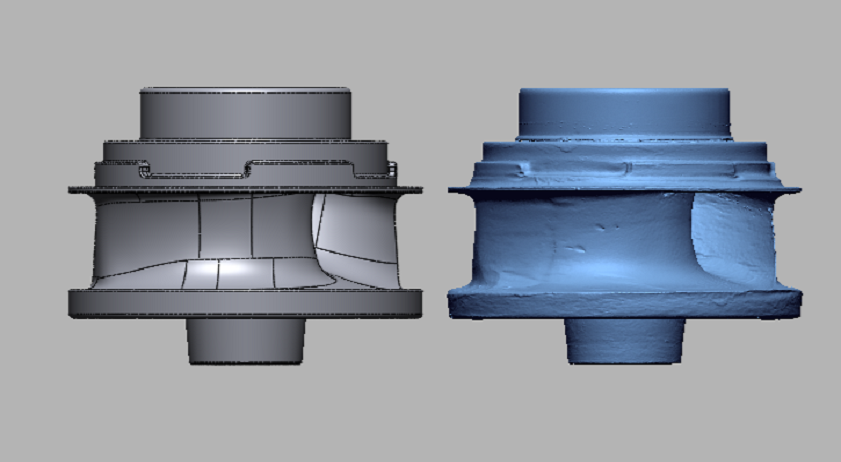
An industrial impeller older than the engineer rebuilding it — no drawings, no specs, every blade worn differently. We delivered a parametric model tied back to the original hydraulic intent.
The problem
The client handed us a single impeller after three decades of service: erosion on the leading edges, cavitation pits, and no two blades that matched. There was no CAD, no drawings, and no surviving spec sheet — but the curvature of those blades is exactly what controls flow rate and head pressure. Copying the worn part would have shipped the wear into the new one.
Our approach
- 1High-resolution capture with the FreeScan Trio across multiple angles to lock down trailing-edge geometry
- 2Per-blade deviation analysis to identify the statistically least-deformed 'golden blade'
- 3Surface patching in Geomagic Design X Pro, converted to parametric sketches with curvature-continuous lofts
- 4Cross-checked the rebuilt blade angle against pump performance tables to validate the original design point
The result
We delivered a fully parametric, CAM-ready CAD package that restored the original hydraulic behaviour — not a copy of a worn part, but a reconstruction of what the impeller was designed to be.
The deep-dive walkthrough of this case — the workflow, the screenshots, and the lessons we kept — lives on the blog.
Read on the blog