All case studies
Consumer
Reverse Engineering
Can you reverse-engineer a chair? Yes — and it is harder than it looks
Soft cushions, organic curves, compound transitions and zero symmetry. A chair pushes scan-to-CAD past the point where mechanical workflows stop being useful.
2 weeks Geomagic Design X Pro, Hybrid surfacing, SolidWorks Consumer
The problem
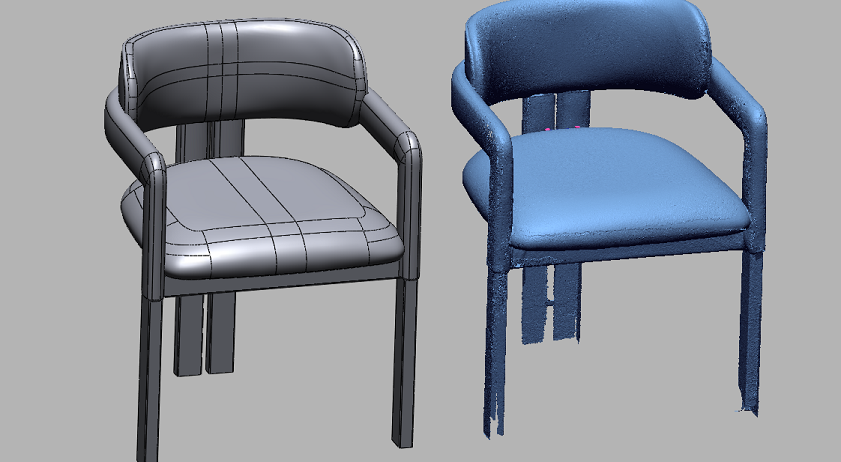
Mechanical parts forgive you — they have datums, primitives and symmetry. A chair has none of that. The cushion sags, the armrests sweep into the backrest with no clean break, fabric folds create scan noise, and there is no obvious place to anchor a coordinate frame. Direct surface fitting on the raw mesh fails almost immediately.
Our approach
- 1Manual sectioning across the seat and back to extract consistent ergonomic profiles
- 2Region growing with curvature filtering to rebuild spline-based contours instead of chasing every fabric fold
- 3Localised mesh repair under the cushion and between folds, with targeted decimation to clean stitching gaps
- 4Hybrid surfacing — primitive features where they existed (frame, base) and constrained NURBS for the organic body
- 5Captured the entire build in the Design X feature tree for parametric editing in SolidWorks
The result
A fully parametric, manufacturable CAD model that preserved the chair's ergonomic intent — ready for furniture reproduction, redesign, digital archiving, or fabrication tooling.