You wanted to hear about a case study and I chose: the impeller. And I chose right — this was one of the most sensitive, technically demanding reverse engineering projects I've done so far. Some projects challenge your skills. Others challenge your judgment. This one did both.
§ The Challenge
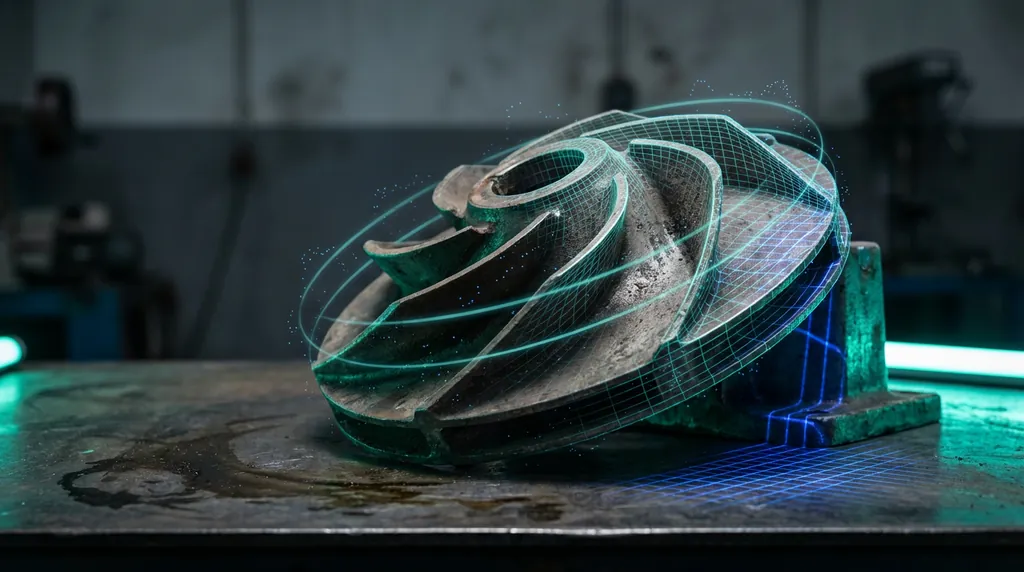
We were handed an industrial impeller that had been in operation for over 30 years — longer than I've been alive. The client had no CAD, no drawings, no specs, just the part. And that part had stories: erosion, fatigue, uneven wear… and not a single blade matched the next.
The mission: rebuild a parametric, high-fidelity CAD model for digital archiving, future manufacturing, and simulation. The catch — the curvature of the blades directly controls flow rate and pressure. One small deviation and the entire system fails. This wasn't just modeling; it was a surgical operation in reverse.
§ Workflow
- Scan acquisition — high-resolution scanning with the FreeScan Trio (SHINING 3D), capturing blade geometry and trailing-edge erosion from multiple angles.
- Blade extraction — manually isolated each blade, ran deviation analysis to find the least-deformed one, and chose a 'golden blade' to rebuild and symmetrically replicate.
- Modeling in Geomagic Design X Pro — surface patches converted to parametric sketches, blades lofted with curvature continuity, hub and base reconstructed with axis alignment and rotational patterns.
§ Engineering Judgment in Action
This wasn't about modeling what the scan showed. It was about understanding what the impeller should have been from a fluid-dynamics perspective. We referenced pump performance tables to validate curvature decisions, matching the intended flow rate and head pressure — locking in the 24° design point for optimal performance reconstruction.
§ Final Deliverables
- Fully parametric CAD model
- Editable blade angle and profile
- CAM-ready geometry for CNC or casting
- Performance confirmed via engineering tables
§ Key Takeaways
- Reverse engineering is not copying — it's reconstructing intent.
- Aging parts tell a story; the real job is decoding it.
- Engineering intuition + precision tools = reliable restoration.
- The older the part, the more respect it deserves — both mechanically and historically.
Was this helpful?
Take it further
Have a part like this? Or want to learn the workflow yourself?