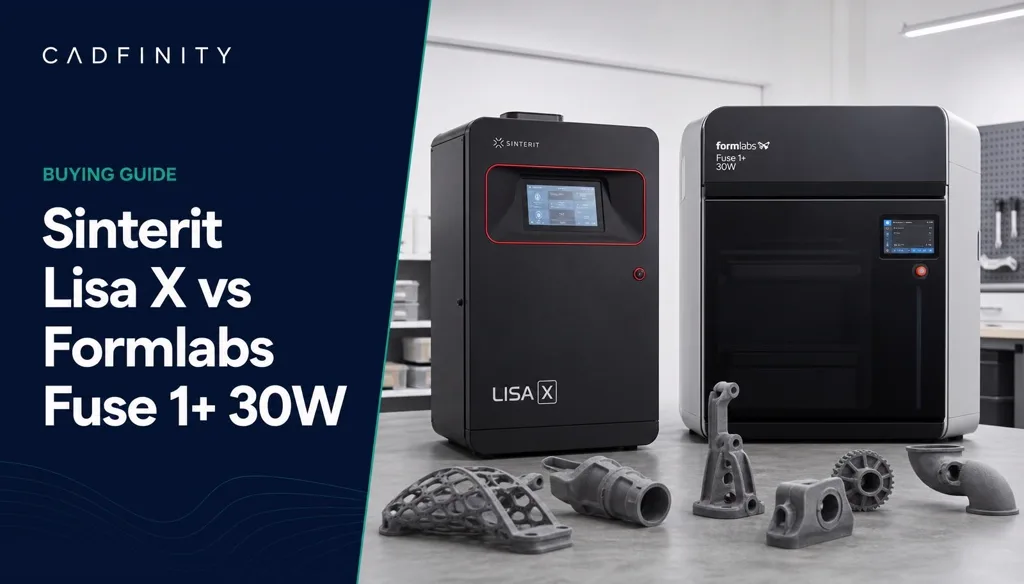
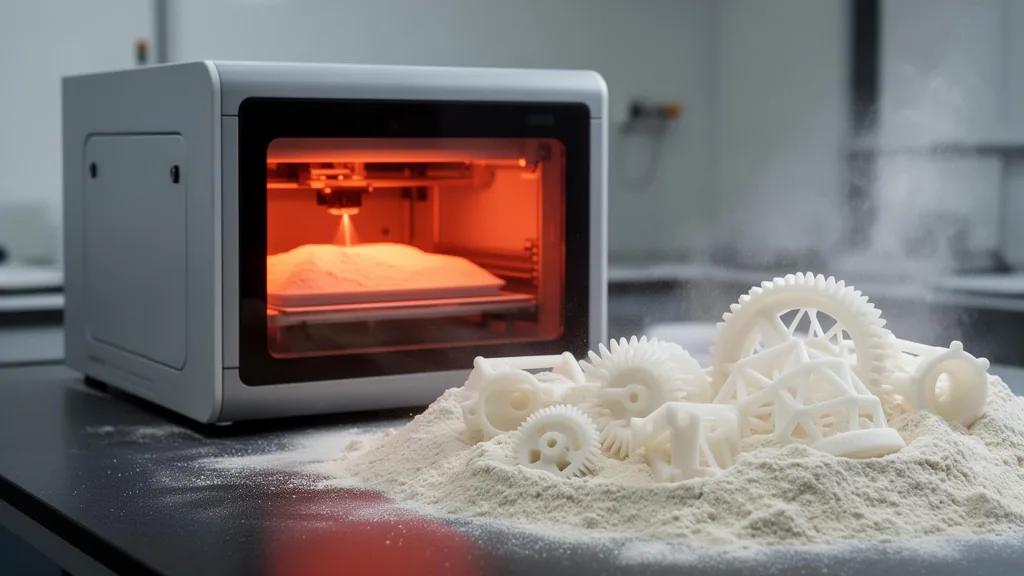
Both compact, both proven, both the same generous build volume — but Sinterit's Lisa X and Suzy are built for very different teams. Lisa X is an open, multi-material R&D platform with full control over 32 print parameters. Suzy is the fourth-generation Sinterit SLS printer, tuned around a single material — PA12 Industrial — for up to 35% faster prints and a streamlined, guided workflow. The right choice comes down to material strategy, budget, and how much control you actually want over the process.
§ Who each printer is for
Suzy is the new definition of productivity for teams who want SLS-grade parts without becoming SLS experts. By focusing on PA12 Industrial, it delivers high mechanical performance and smooth surface finish out of the box, with onscreen step-by-step instructions that make it accessible to operators new to powder-bed printing. Lisa X is the versatile, open-architecture champion — built for advanced users who need granular control, multi-material freedom, and Industry 4.0 integration into smart manufacturing lines.
- Suzy — small businesses, in-house prototyping teams, dental/medical labs, service providers, and educational institutions that want predictable PA12 output at the lowest entry point.
- Lisa X — service bureaus, R&D labs, universities, material developers, and aerospace/automotive teams that need PA11, PA11 CF, Polypropylene, elastomers, or third-party powders.
§ Spec comparison — Lisa X vs Suzy
| Spec | Sinterit Lisa X | Sinterit Suzy |
|---|---|---|
| Technology | Selective Laser Sintering (SLS) | Selective Laser Sintering (SLS) |
| Generation | Flagship open SLS platform | 4th-generation Sinterit SLS |
| Build volume (X × Y × Z) | 130 × 180 × 330 mm | 130 × 180 × 330 mm |
| Min. layer height | 75 μm (0.075 mm) | 75 μm (0.075 mm) |
| Laser | 30 W IR diode laser, galvo-driven | 30 W IR diode laser, galvo-driven |
| Print speed | Reference baseline | Up to ~35% faster — large builds in under 24 h |
| Material strategy | Open — PA12, PA11, PA11 CF, Polypropylene (PP), TPE/Flexa elastomers, third-party powders | Closed — PA12 Industrial only (single, fully tuned profile) |
| Material switch | ~30 minutes between powders | Single-material workflow, no switching |
| Parameter control | Full open access to 32 print parameters — laser power, scan speed, temperature, scale, hatching, per-model overrides | Validated PA12 profiles, guided onscreen workflow |
| Software | Sinterit Studio — full parameter mode + per-model tuning | Sinterit Studio — simplified, step-by-step mode |
| Industry 4.0 / API | Yes — first compact SLS with API integration for smart manufacturing | Standard connectivity, focused on standalone use |
| Connectivity | Wi-Fi, Ethernet, USB | Wi-Fi, Ethernet, USB |
| Ideal user | Advanced users, R&D, material researchers, service bureaus | Designers, engineers, educators, low-to-mid batch production |
| Starting price | Higher tier — premium for openness and versatility | The most accessible Sinterit SLS — entry-level pricing |
§ Total cost of ownership beyond the printer
Sinterit positions Suzy as the affordable entry point into real SLS — fully tuned around PA12 Industrial and engineered to drop your cost-per-part for low-to-medium batch production. Lisa X carries a higher ticket, justified by multi-material capability, 32 open print parameters, and Industry 4.0 integration. In both cases, the printer is roughly half of what you'll spend in year one.
- Powder refresh ratio — typically 30–50% fresh PA12 mixed with reused powder per build. PA11 and CF blends on Lisa X are more demanding.
- Depowdering & sandblasting station — non-negotiable for clean parts and operator safety.
- Powder storage — sealed, dry, dated; track refresh ratios per batch.
- Sinterit Studio — included on both, but Suzy's guided mode shortens the learning curve dramatically.
- Annual service — laser check, optics cleaning, software updates.
§ How to actually choose
Sinterit's own framing is the clearest way to decide: align the printer with your material strategy, your budget, your user experience, and your production turnaround.
- Material strategy — Suzy if you'll print mostly PA12 Industrial; Lisa X if you need PA11, PA11 CF, Polypropylene, elastomers, or third-party powders.
- Budget & investment — Suzy is the most accessible Sinterit SLS, ideal for cost-sensitive teams and education. Lisa X is justified when versatility and parameter control unlock new applications.
- User experience — Suzy guides operators step by step; Lisa X rewards experienced users who want to fine-tune every print.
- Production volume & turnaround — Suzy's ~35% speed advantage and 24-hour large builds favour time-sensitive production; Lisa X's flexibility favours diverse, short-run jobs across multiple powders.
§ Where SLS fits in the wider tool chain
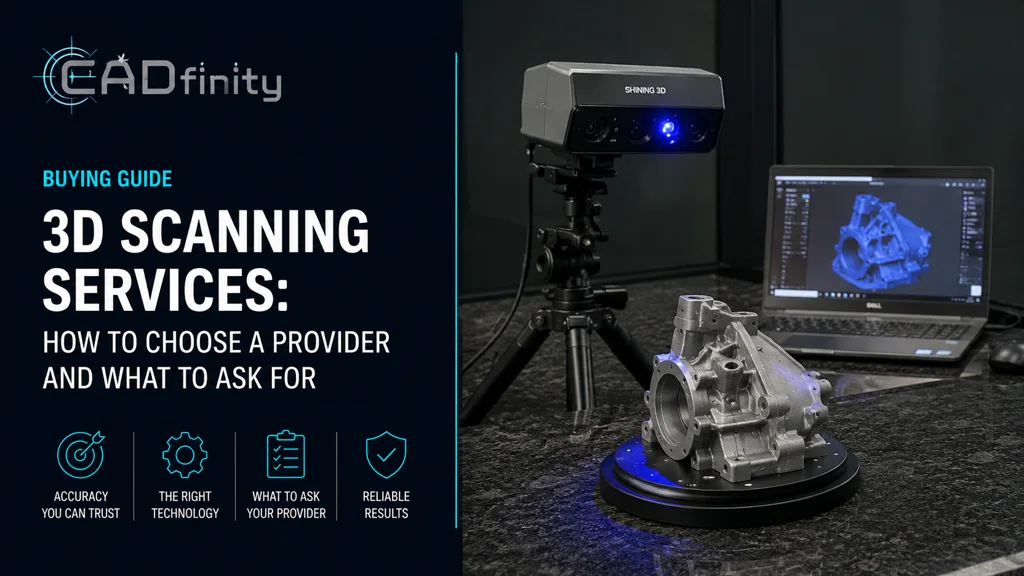
SLS gives you isotropic, support-free, functional plastic parts — perfect for snap-fits, living hinges, complex internal channels, and small production runs. Pair it with a good 3D scanner for reverse engineering existing parts (see our guide on how to choose a 3D scanner) and you have an end-to-end physical-to-digital-to-physical workflow. Many CADfinity clients run an SLS printer alongside a SHINING 3D scanner and Geomagic Design X for exactly this loop.
Was this helpful?
Take it further
Have a part like this? Or want to learn the workflow yourself?