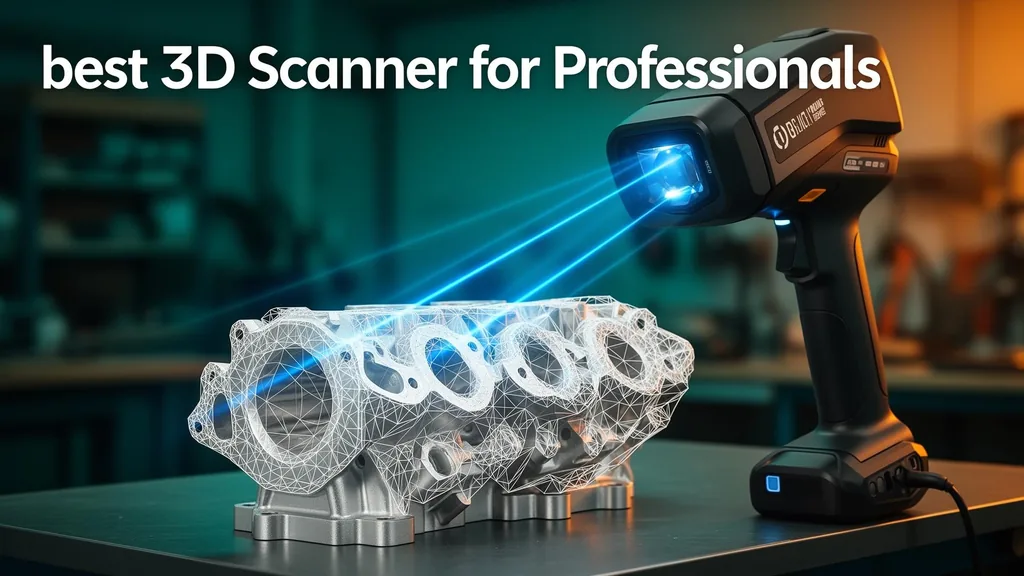
SHINING 3D's professional all-in-one line is now built around two purpose-built systems: the EinScan Rigil — a tri-mode laser 3D scanner with built-in computing, blue laser plus IR VCSEL, and an iF Design Award 2026 — and the EinScan Medixa, a dedicated all-in-one scanner for orthotics & prosthetics workflows. Each one is the right answer for a very specific kind of buyer; getting the choice right starts with what (and who) you actually scan.
§ Who this tier is for
- Reverse-engineering service providers selling scan-to-CAD across automotive, fab shops, and aftermarket.
- In-house design teams modernizing legacy parts, custom kits, and field-measured assemblies.
- Cultural creation, art and heritage studios needing high-fidelity geometry plus colour texture.
- Research, education and field-research teams that need a portable, cable-free scanner with on-device computing.
- Orthotics & prosthetics clinics digitizing patients for cranial helmets, sockets, AFOs, custom seating, and footwear.
§ Spec comparison — EinScan Rigil vs EinScan Medixa
| Spec | EinScan Rigil | EinScan Medixa |
|---|---|---|
| Form factor | All-in-one handheld with built-in compute, screen, storage and battery | All-in-one handheld with built-in compute, screen and dual hot-swap batteries |
| Work modes | Wireless Standalone | PC-Wireless (Wi-Fi 6) | PC-Wired (USB-C) | Wireless Standalone (no PC required) |
| Light source | Blue laser + IR VCSEL (hybrid) | White light + IR VCSEL |
| Scan modes | Laser HD (25+25 crossed laser lines, 7 parallel) and IR Rapid | Pre-configured presets: Face, Cranial, Torso, Upper limb, Lower limb, Feet, Socket, Seating, Foam box |
| Resolution / point distance | Laser HD: 0.05 – 10 mm | IR Rapid: 0.2 – 10 mm | 0.2 – 3 mm |
| Scan speed | Laser HD: up to 4,800,000 pts/s | IR Rapid: up to 16,000,000 pts/s | Optimized for capture of full body / cranial in seconds |
| Working distance | Laser HD: 170 – 550 mm | IR Rapid: 160 – 1500 mm | Body-scanning range with patient-friendly stand-off |
| Field of view | Wide-area capture for vehicles, panels, large props | White light: 475 × 360 mm | IR VCSEL: 1090 × 1260 mm |
| Marker handling | Marker-free laser scanning supported; Global Markers / Markers / Features / Texture / Hybrid alignment | Feature / Texture / Hybrid / Markers / Global markers |
| Texture / colour | 5 MP HD camera for geometry + colour texture | 5 MP texture camera; supports clinician-drawn surface markings |
| Special features | Tri-mode workflow, scene-adaptive scanning, advanced hybrid tracking (4 modes), iF Design Award 2026 | Movement compensation for breathing patients and infants, contact-free, tailored O&P presets |
| Software | EinScan Rigil App (on-device) + EXScan Rigil (PC) + EXModel + BlueStar Mapping | On-device O&P workflow with STL/OBJ/PLY export to CAD/CAM and O&P design software |
| Best for | Automotive aftermarket & engineering, cultural creation & art, research & education, in-field reverse engineering | Orthotics & prosthetics clinics, paediatric cranial scanning, prosthetic socket capture, custom footwear and seating |
§ How to actually choose between them
These two scanners barely overlap. The decision is almost entirely about what (and who) you scan every week.
- Pick EinScan Rigil if you scan vehicles, fabrication parts, props, sculptures or any industrial geometry. The hybrid blue-laser + IR VCSEL light source plus marker-free workflow handles dark, shiny, and complex surfaces, while the tri-mode design lets you scan untethered in the field and dock to a workstation in the office for heavy projects.
- Pick EinScan Medixa if your patients are your subjects. Movement compensation, the body-friendly white-light + IR VCSEL combo, and pre-configured O&P scan presets make it the right tool for cranial helmets, prosthetic sockets, AFOs, custom footwear and clinical seating — none of which a general-purpose scanner is optimized for.
- Buy both if you run an integrated medical and industrial design service: Rigil for the device shell and tooling, Medixa for the patient-side digitization. They share the same SHINING 3D ecosystem and export pipeline.
§ When to step up to metrology-grade
§ Don't forget the workflow after the scan
The scanner is the first 30% of the job. A reverse-engineering workflow on Rigil needs Geomagic Design X (or equivalent) to convert the mesh into parametric CAD; an O&P workflow on Medixa connects to ordering systems, CAD/CAM, and milling. Budget for both the scanner and the downstream pipeline, and make sure your reseller can train your team end-to-end — not just on the hardware.
Was this helpful?
Take it further
Have a part like this? Or want to learn the workflow yourself?