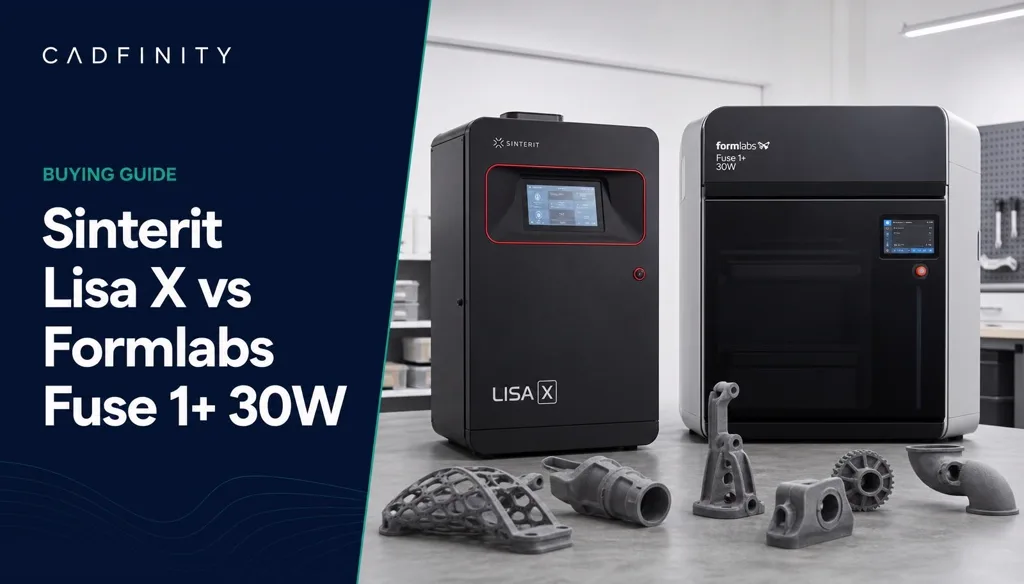
The Sinterit Lisa X and the Formlabs Fuse 1+ 30W are the two machines that show up on every benchtop SLS shortlist. Both use a 30 W laser, both print nylon, both fit in a workshop without a facility retrofit. The difference is philosophy: Lisa X is an open system that lets you run any powder you can qualify, and the Fuse 1+ 30W is a tightly tuned ecosystem that trades that freedom for repeatability. This comparison is written the way we advise clients — around throughput, powder economics and post-processing, not marketing claims.
§ Head-to-head specifications
| Sinterit Lisa X | Formlabs Fuse 1+ 30W | |
|---|---|---|
| Technology | SLS, powder bed fusion | SLS, powder bed fusion |
| Laser | 30 W IR fibre-coupled diode (~976 nm) | 30 W ytterbium fibre laser |
| Build volume | 130 × 180 × 330 mm (tall format) | 165 × 165 × 300 mm |
| Layer thickness | 0.075 – 0.175 mm | 0.110 mm (Nylon 12) |
| Material strategy | Open — any qualified powder, editable print profiles | Validated Formlabs powders only |
| Powder range | PA12, PA11, TPE/flexible, PP-like, plus third-party powders | Nylon 12, Nylon 11, Nylon 12 GF, TPU, Nylon 11 CF |
| Powder refresh | Depends on powder; commonly ~30 – 50 % fresh | ~30 % fresh for Nylon 12 |
| Post-processing | Sandblaster SLS, separator, ATEX vacuum, multi-PHS | Fuse Sift (integrated recovery) + Fuse Blast (automated cleaning) |
| Indicative price | From ~$29k printer only; ~$45k performance set | ~$40k+ printer; full package with Sift/Blast typically higher |
| Best fit | Labs and R&D teams that need material freedom | Product teams and bureaus that need repeatable throughput |
§ Build volume: taller vs squarer
On paper the Fuse 1+ 30W has the bigger chamber by volume, but the shapes are different in a way that matters. Lisa X gives you 330 mm of Z in a narrow footprint, which is excellent for tall, slender parts — ducting, handles, housings stood on end. The Fuse 1+ 30W's squarer 165 × 165 mm bed nests small parts more efficiently, and packing density is what actually drives cost per part in SLS. If you print one big part at a time, Lisa X's height wins. If you print fifty small parts at a time, the Fuse's bed geometry usually wins.
§ Print quality, side by side
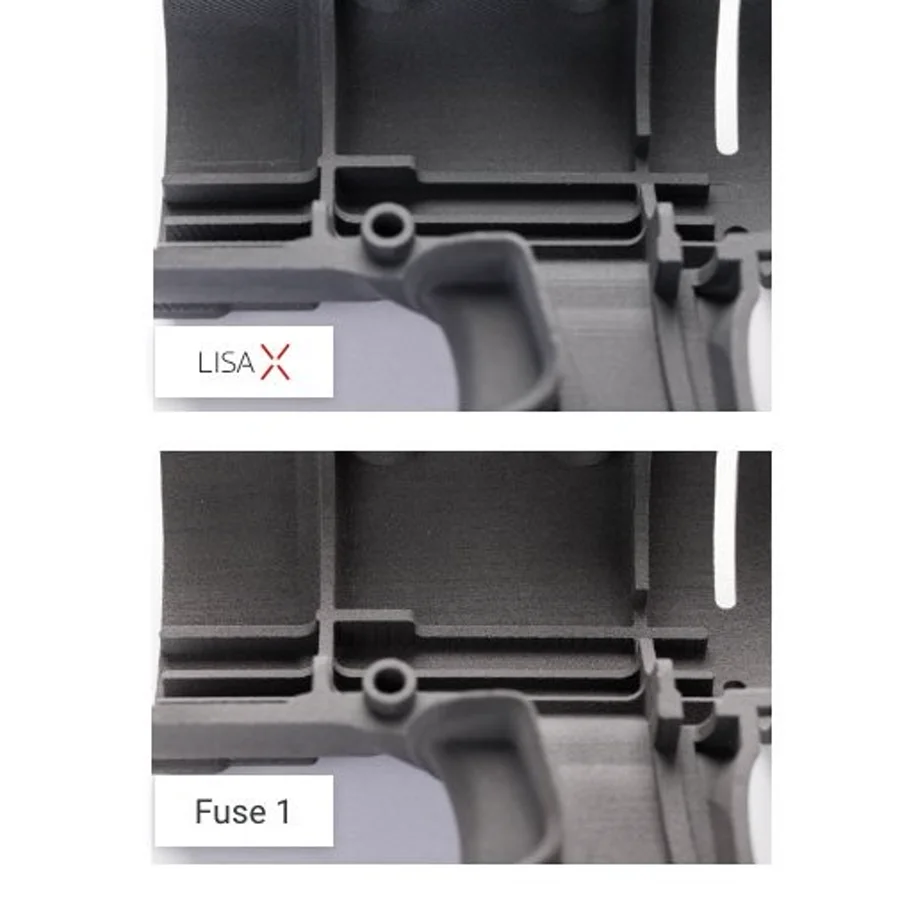
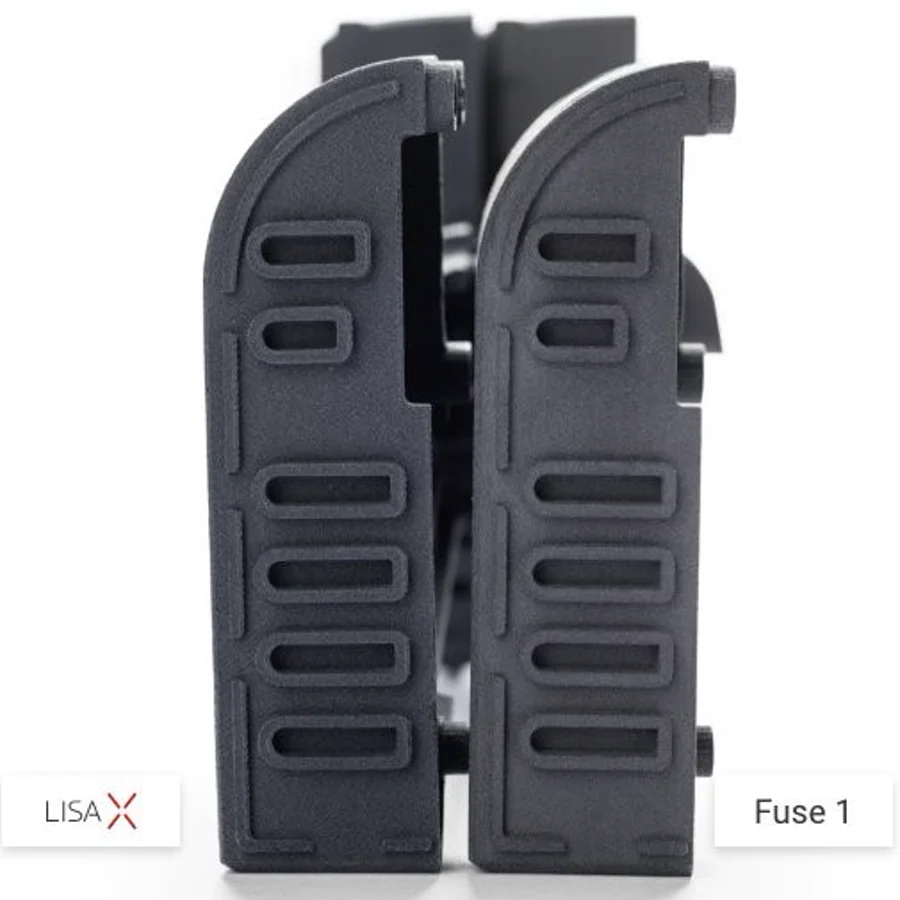
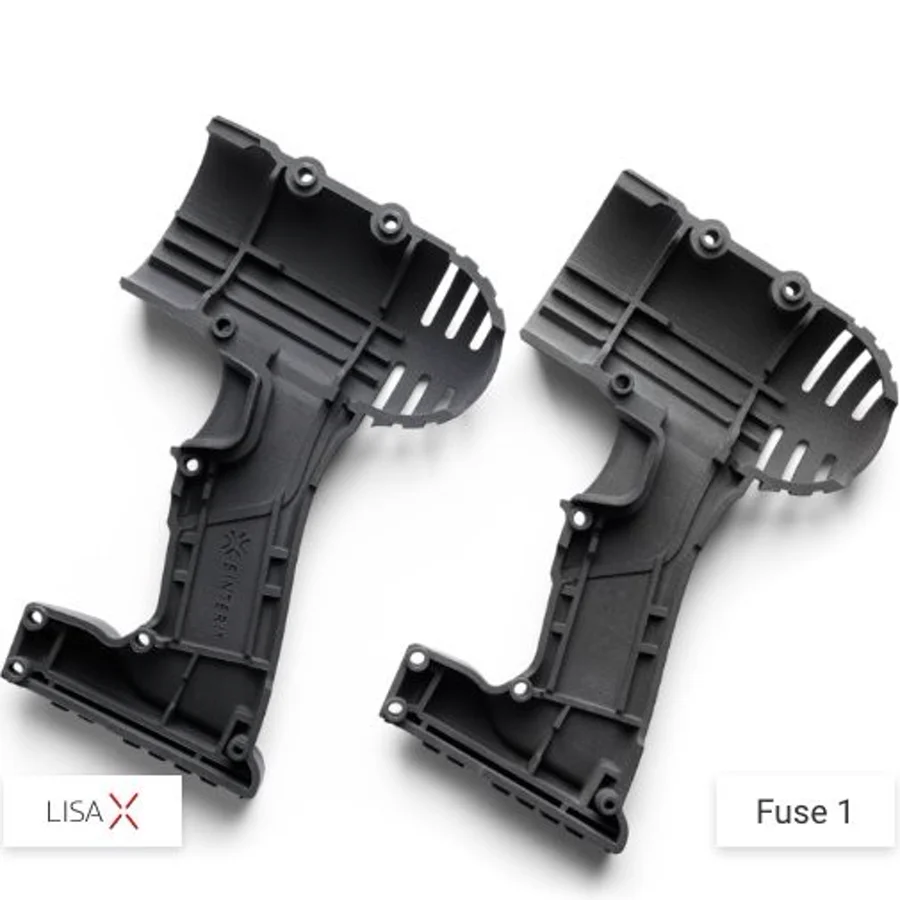
The same part printed on both machines is the fairest test there is. Below are identical geometries — a housing, a ribbed cover and a tool body — printed on the Lisa X and the Fuse 1+ 30W. Look at edge definition on the thin ribs, the crispness of the small bosses and holes, and the uniformity of the surface texture rather than at overall colour.
§ Materials: open architecture vs validated ecosystem
This is the real decision. Sinterit's open architecture exposes laser power, layer time and bed temperature, so you can qualify a third-party powder or dial in a flexible TPE that no OEM sells for your machine. That is genuinely valuable in research, in medical device development, and anywhere the material is the experiment. It also means you own the process development: if a build fails, it is your parameter set.
Formlabs goes the other way. You get a shorter material list, all validated, with print profiles you do not touch. In exchange, the first build usually works and the tenth build looks like the first. For a design team producing functional prototypes and end-use parts on a schedule, that predictability is worth more than parameter access they would never use.
§ Post-processing is where the hours go
Everyone compares printers; almost nobody compares depowdering. Formlabs' Fuse Sift combines powder recovery and mixing in one enclosed station, and Fuse Blast automates bead blasting and polishing — that combination is the strongest argument for the Fuse ecosystem, because it turns the messiest part of SLS into a repeatable, mostly hands-off routine. Sinterit sells the equivalent capability as separate modules (sandblaster, separator, ATEX vacuum, powder handling station), which is more flexible and often cheaper, but requires more manual handling and more discipline about powder hygiene.
§ What each machine really costs to run
- Powder: budget the refresh ratio, not the bag price. A 30 % refresh means roughly a third of every build volume is new powder, forever.
- Consumables and safety: nitrogen (where used), filters, blast media, ATEX vacuum bags, gloves and masks. Small individually, real annually.
- Labour: 1 – 3 hours per build in setup, sifting, depowdering and finishing. This is the biggest hidden line item on either machine.
- Downtime: an open machine that lets you tune profiles also lets you waste a build tuning profiles. Cost that learning curve honestly.
- Service: Formlabs service plans and Sinterit service sets are priced separately — compare quotes with the same coverage period.
§ Who should buy which
| If you... | Buy | Why |
|---|---|---|
| Print functional Nylon 12 prototypes weekly on a deadline | Fuse 1+ 30W | Validated profiles plus Sift/Blast means fewer failed builds and predictable finishing time |
| Develop or qualify your own powders | Lisa X | Open parameters and open material access are not available on the Fuse |
| Need tall parts in a small room | Lisa X | 330 mm Z in a narrow benchtop footprint |
| Run a service bureau nesting many small parts | Fuse 1+ 30W | Squarer bed nests better; ecosystem scales with a second build chamber |
| Have the lowest capital budget for real SLS | Lisa X | Lowest entry price into professional nylon SLS |
| Are already outgrowing benchtop SLS | Neither — look at Fuse X1 | 330 × 330 × 565 mm large-format SLS changes the economics entirely |
§ Questions buyers ask us
- Which is more accurate? In practice both hold roughly ±0.3 % of nominal (min ±0.3 mm) on nylon. Neither replaces machining for tight-tolerance features — design in a machining allowance, or verify with a scan and a deviation report.
- Can I run third-party powder in the Fuse? No. If that is a requirement, the decision is already made.
- Do I need a dedicated room? Not a cleanroom, but you do need ventilation, ESD-safe handling and somewhere to depowder without contaminating benches. Both vendors assume this.
- How long does a build take? Both are hours-not-minutes machines: a full, well-packed chamber is typically an overnight run plus cool-down. Cool-down is not optional and is not marketing time.
- Can I scan and reverse engineer parts to print on these? Yes — that is most of our client work. Scan the legacy part, rebuild it as parametric CAD, then print in nylon.
Was this helpful?
Take it further
Have a part like this? Or want to learn the workflow yourself?