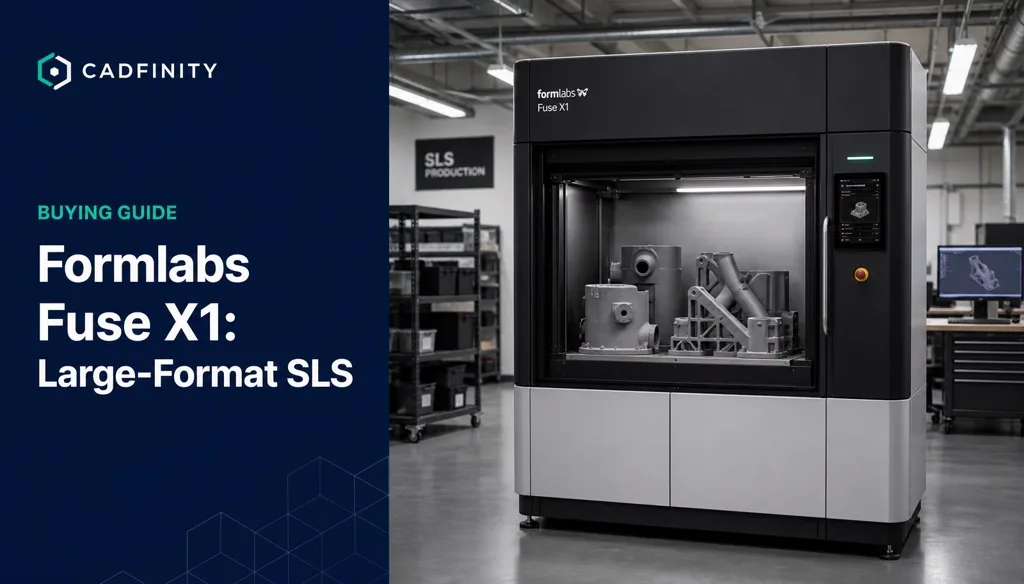
On 9 June 2026 Formlabs announced the Fuse X1, a large-format selective laser sintering ecosystem starting at $84,999 with deliveries from Q4 2026. The headline is size — a 330 × 330 × 565 mm build volume — but the number that matters to anyone costing parts is packing density: over 30 %, with claimed 3x the throughput and around 50 % lower part cost than competing industrial systems, in half the floorspace. This is our read on what actually changes.
§ The specification, plainly
| Item | Fuse X1 |
|---|---|
| Technology | SLS (powder bed fusion) |
| Build volume | 330 × 330 × 565 mm |
| Packing density | 30 %+ |
| Throughput | Up to 3x competing systems; same-day large parts |
| Part cost | Up to ~50 % lower than legacy powder bed fusion |
| Footprint | Under half the floorspace of comparable industrial SLS; fits through a standard door |
| Process control | AI-assisted print intelligence and in-process monitoring |
| Starting price | $84,999 |
| Availability | Orders from June 2026, deliveries from Q4 2026 |
§ Why packing density is the real headline
In SLS, you heat and sinter an entire chamber whether it is full or not. Cost per part is therefore dominated by how much of the chamber you fill and how much powder you have to refresh. Benchtop machines typically run in the 8 – 12 % packing range in practice. If the Fuse X1 sustains 30 %+ in real production nesting, the same set of parts consumes far less machine time and far less powder per unit — and that, not the chamber dimensions, is what makes it competitive with injection moulding into the tens of thousands of parts.
§ Fuse X1 vs Fuse 1+ 30W
| Fuse 1+ 30W | Fuse X1 | |
|---|---|---|
| Build volume | 165 × 165 × 300 mm | 330 × 330 × 565 mm |
| Positioning | Benchtop, prototype and low-volume end-use | Industrial, production and large parts |
| Entry price | Tens of thousands | $84,999+ |
| Best for | Design teams, labs, low-mix low-volume | Bureaus, manufacturers, series production |
| Bottleneck it removes | Access to SLS at all | Chamber size and throughput |
The Fuse 1+ 30W does not become obsolete. It remains the right first SLS machine for a design team producing a few builds a week. The Fuse X1 is a manufacturing purchase: you buy it when SLS is already a bottleneck in your production flow, or when parts simply do not fit in a benchtop chamber.
§ Who should be looking at it
- Service bureaus whose Fuse fleet runs near-continuously and who are turning away large parts.
- Manufacturers making jigs, fixtures and manufacturing aids at volume, where lead time and part cost both matter.
- Product companies producing end-use nylon parts in the hundreds-to-thousands per month range.
- Teams comparing SLS against low-volume injection moulding — the part-cost curve is the whole argument.
- Anyone whose parts exceed roughly 300 mm in any axis today and are being split and bonded to fit.
§ Who should wait
- Teams printing fewer than a few builds per week — you will not fill the chamber, and an unfilled SLS chamber is the most expensive way to print.
- Labs that need open-parameter material development; the Formlabs ecosystem is validated, not open.
- Anyone with a Q3 deadline: deliveries start Q4 2026.
- Buyers who have not yet costed powder refresh, depowdering labour and finishing on their actual part mix.
§ Questions to ask before you sign
- What packing density do you achieve on my part geometry, not a demo nest?
- What is the verified powder refresh ratio per material, and what does that cost per kilogram of parts?
- What is the full build cycle including cool-down, and how many builds per week can one operator sustain?
- What does the post-processing chain look like end-to-end, and how much of it is automated?
- What are the facility requirements — power, extraction, floor loading, door clearance?
- What does service coverage cost per year, and what is the response time in my region?
§ Frequently asked
- When can I get one? Orders opened in June 2026 with deliveries starting Q4 2026.
- How big is the build volume? 330 × 330 × 565 mm.
- How much does the Fuse X1 cost? Starting at $84,999 for the system, before post-processing hardware, materials and service.
- Does it need a facility retrofit? Formlabs states it fits through a standard door and installs without a retrofit — still verify power and extraction for your site.
- Can I print reverse-engineered legacy parts on it? Yes. Scan the part, rebuild it as parametric CAD with the correct fits and tolerances, then print in nylon — that is exactly the workflow we run for clients.
Was this helpful?
Take it further
Have a part like this? Or want to learn the workflow yourself?