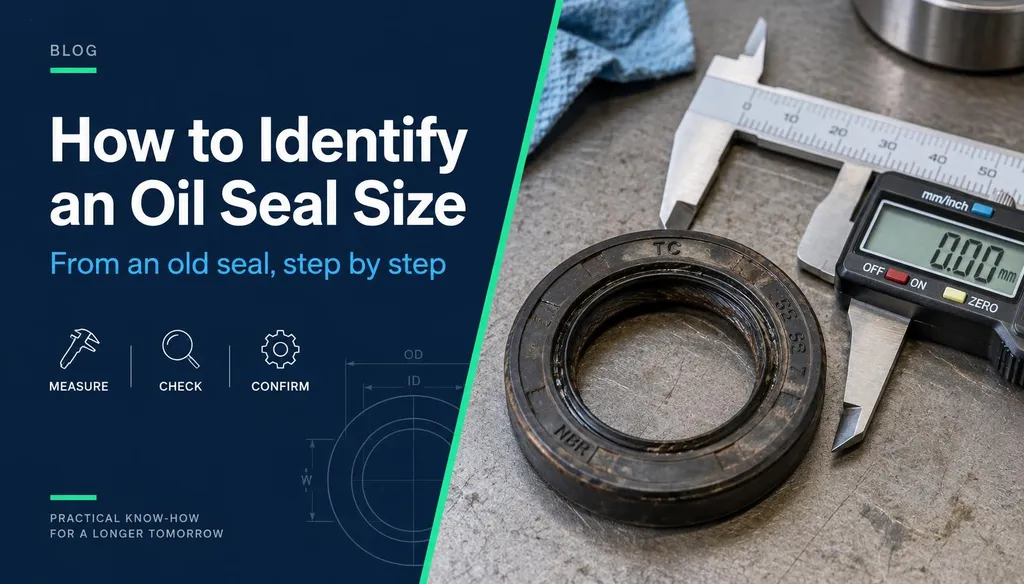
An oil seal fails, the number is worn off, and the machine is down. Radial shaft seals are sized by three numbers — shaft Ø × housing bore Ø × width (e.g. 35×52×7) — plus a lip type and a material. Here's how to recover all of them from an old seal and the parts around it.
§ Step 1 — Look for markings first
Clean the outer face with solvent and check under angled light. Most seals are stamped with size (35x52x7 or 35-52-7), type (TC, SC, TB, VC…), material (NBR, FKM/FPM, VMQ) and sometimes a maker's part number. If you can read it, you're done — just confirm with Step 2.
§ Step 2 — Measure the shaft, not the seal lip
The seal lip is designed smaller than the shaft and stretches when fitted, then wears — so measuring the old lip ID gives a wrong answer. Measure the shaft where the lip ran, just outside the wear groove, with a micrometer. Round to the nearest standard size (ISO 6194 / DIN 3760 sizes are whole millimetres in most ranges).
§ Step 3 — Measure the housing bore
Measure the bore with an inside micrometer or bore gauge at two angles. If the housing isn't accessible, measure the old seal's OD — the outer case barely wears — and round down to the nearest whole millimetre (seal OD has a small press-fit allowance of +0.1 to +0.3 mm).
§ Step 4 — Measure the width
Measure the seal width with a caliper at several points. Common widths are 5, 6, 7, 8, 10 and 12 mm. If the housing is deeper than the seal, you can often go one step wider for a longer life — but check the shaft has room.
| Shaft (measured) | Old seal OD | Width | Order size |
|---|---|---|---|
| 34.98 mm | 52.18 mm | 7.0 mm | 35×52×7 |
| 24.95 mm | 40.15 mm | 6.9 mm | 25×40×7 |
| 1.497 in | 2.253 in | 0.25 in | 1.500×2.250×0.250 |
§ Step 5 — Identify the lip type
- TC — rubber-covered case, spring lip + dust lip. The most common general-purpose seal.
- SC — rubber-covered case, single spring lip, no dust lip. Clean environments.
- TB / SB — metal case outside, with or without dust lip. Tighter fit, harder to seal rough bores.
- VC / KC — no spring. Grease retention, low pressure.
- Double-lip or pressure types — look for a short, stiff lip; needed above ~0.5 bar.
§ Step 6 — Choose the material
| Material | Temp range | Use when |
|---|---|---|
| NBR (nitrile) | −40 to +100 °C | Mineral oils, grease, general machinery |
| FKM / Viton | −20 to +200 °C | High temperature, synthetic oils, chemicals |
| VMQ (silicone) | −60 to +180 °C | Wide temperature range, low friction, no pressure |
| PTFE lip | −80 to +200 °C | High speed, dry running, aggressive media |
Was this helpful?
Take it further
Have a part like this? Or want to learn the workflow yourself?