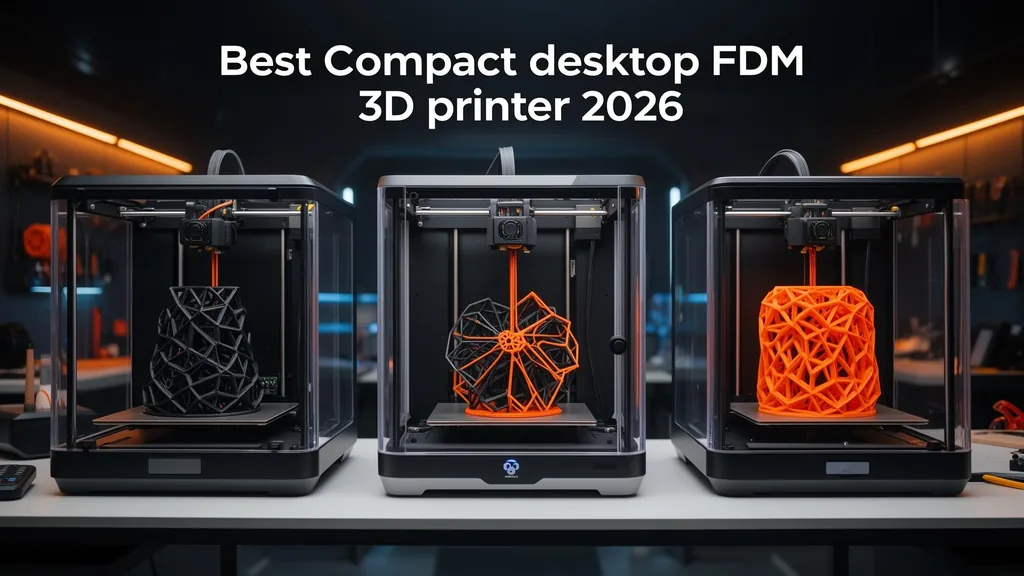
In 2026, 'compact and durable desktop FDM' has a clear definition: a fully enclosed CoreXY frame, hardened steel nozzle, all-metal hotend, an actively or passively heated chamber, and a footprint that fits next to a monitor. Three printers dominate this segment: Bambu Lab P1S, Creality K1C, and Elegoo Centauri Carbon. Each one is the strongest pick for a different kind of buyer.
§ The three contenders
Bambu Lab P1S is the maturity pick. CoreXY, fully enclosed, AMS multi-material support, and the most polished software stack on the market with Bambu Studio and MakerWorld. It's not the cheapest, but it's the printer most engineers buy when they want to stop tinkering and start using.
Creality K1C is the value-engineered workhorse. Hardened nozzle out of the box, fully enclosed CoreXY, AI camera, and Creality's enormous parts and accessory ecosystem. Frequently discounted aggressively, it's the most accessible credible carbon-capable enclosed CoreXY from a major brand.
Elegoo Centauri Carbon is the disruptor. Released in late 2024 and refined through 2025, it pairs a carbon-fibre-ready hotend, fully enclosed CoreXY frame, and a 256 mm³ build volume with aggressive street pricing. For a designer or maker who wants Bambu-class hardware at the most accessible point in the segment, it's the default 2026 recommendation.
§ Spec comparison — P1S vs K1C vs Centauri Carbon
| Spec | Bambu Lab P1S | Creality K1C | Elegoo Centauri Carbon |
|---|---|---|---|
| Kinematics | CoreXY, fully enclosed | CoreXY, fully enclosed | CoreXY, fully enclosed |
| Build volume (X × Y × Z) | 256 × 256 × 256 mm | 220 × 220 × 250 mm | 256 × 256 × 256 mm |
| Max nozzle temperature | 300 °C | 300 °C | 320 °C |
| Max bed temperature | 100 °C | 100 °C | 110 °C |
| Hardened nozzle | Optional upgrade | Standard (tri-metal) | Standard (hardened) |
| Carbon-fibre filament ready | Yes (with hardened nozzle + AMS HT) | Yes — out of the box | Yes — out of the box |
| Top print speed | 500 mm/s | 600 mm/s | 500 mm/s |
| Max acceleration | 20,000 mm/s² | 20,000 mm/s² | 20,000 mm/s² |
| Auto bed leveling | Yes (lidar-assisted) | Yes (strain-gauge) | Yes (full-auto) |
| Multi-material | AMS / AMS 2 Pro (up to 16 colors) | Single-material (CFS supported on K2 line) | Single-material at launch |
| Enclosure & filtration | Glass + active carbon filter | Glass + active carbon filter | Glass + active carbon filter |
| Camera | 1080p (P1S) | 1080p AI camera (failure detection) | 1080p |
| Connectivity | Wi-Fi, Bambu Cloud, LAN-only mode | Wi-Fi, Creality Cloud, LAN | Wi-Fi, Elegoo Cloud, LAN |
| Slicer | Bambu Studio + Orca Slicer + MakerWorld | Creality Print + Orca Slicer | Elegoo Slicer (PrusaSlicer fork) + Orca |
| Approx. footprint | 389 × 389 × 458 mm | 355 × 355 × 480 mm | 400 × 400 × 490 mm |
| Warranty | 12 months | 12 months | 12 months |
| Positioning | Mature flagship — premium ecosystem | Value-engineered workhorse — frequently discounted | Disruptor — most accessible in the segment |
§ Durability deep-dive — what actually wears out
Compact CoreXY printers all look similar on paper. What separates a one-year tool from a five-year tool is the wear story: nozzles, belts, bearings, hotend life, and how easy it is to source spares in the GCC.
- Nozzle wear — carbon-fibre and glass-fibre filaments shred a brass nozzle in under 1 kg. K1C and Centauri Carbon ship hardened; P1S needs the hardened upgrade or AMS HT nozzle.
- Frame rigidity — all three use folded-steel enclosures with glass doors. K1C and Centauri Carbon are the most rigid for their footprint; P1S trades a little rigidity for a quieter, lighter enclosure.
- Belts and bearings — CoreXY belts stretch over time. Bambu and Creality both publish service intervals; Elegoo's documentation is improving but still less mature.
- Hotend life — all three use ceramic or PTC heaters with thermistors that are field-replaceable, and replacement hotends are inexpensive consumables.
- Spare-parts ecosystem in the GCC — Bambu and Creality have the deepest distributor network in the Gulf; Elegoo is catching up fast through partners like 2bdigital.ae.
§ Software and ecosystem
If you only care about the printer, look at the spec table. If you care about the next two years of using it, look at the ecosystem. Bambu Studio + MakerWorld is the most polished closed-loop slicer-and-model-library combo on the market — calibrated profiles for almost every filament, one-click cloud printing, and a community of millions. Creality Print has caught up significantly and integrates well with Orca Slicer for power users. Elegoo's slicer is functional but newer; most Centauri Carbon owners run Orca Slicer in practice.
§ How to actually choose
- Pick Bambu Lab P1S if — you want the most polished software ecosystem, multi-material printing via AMS, and a printer your team won't fight. Worth the premium for design firms and engineering offices.
- Pick Creality K1C if — you want hardened nozzle out of the box, the largest spare-parts ecosystem in the GCC, and the lowest sale prices from a top-three brand. Best for schools, makerspaces, and budget-conscious engineering teams.
- Pick Elegoo Centauri Carbon if — you want Bambu-class hardware at the lowest price, you mainly print engineering filaments (PA-CF, PETG-CF, ABS), and you don't need multi-material at launch. Best dollar-per-mm-of-build-volume in the segment.
§ Where desktop FDM fits in the engineering workflow
Desktop FDM handles fast iteration and functional prototypes. For larger parts, finer surface finish, or true production runs you'll move up to industrial FDM, SLA, or SLS — see our Sinterit Lisa X vs Suzy guide for compact SLS, or our 3D scanner buying guide if your workflow starts with reverse engineering an existing part.
Was this helpful?
Take it further
Have a part like this? Or want to learn the workflow yourself?