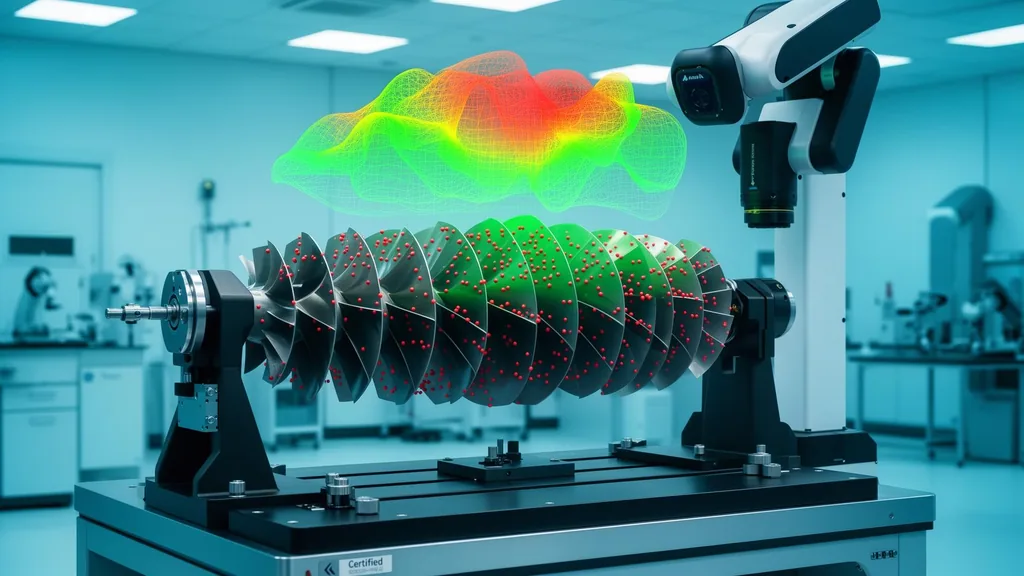
Metrology-grade scanning is a different conversation from professional scanning. At this tier the question stops being 'how detailed is the mesh?' and becomes 'can I defend this measurement in an audit?'. SHINING 3D's 2026 metrology lineup answers that question with four very different tools — FreeScan Combo+, FreeScan UE Pro2, FreeScan Omni, and FreeScan Trak Nova — every one of them with verified accuracy per VDI/VDE 2634 Part 3 and ISO 10360, tested in SHINING 3D's ISO/IEC 17025-accredited Accuracy Lab.
§ Who this tier is for
- Aerospace and automotive QC labs running first-article and serial inspection.
- Tier-1 suppliers reporting against ASME Y14.5 or ISO 1101 GD&T tolerances.
- Casting, forging, and additive shops verifying complex geometry against CAD.
- Metrology service bureaus and shop-floor inspection teams that need scan-to-report on the move.
- Heavy industry, rail, energy, and large-asset measurement where parts can't come to a CMM.
§ Certified vs typical accuracy — why it matters here
A professional-tier scanner might quote 'accuracy up to 0.02 mm' — that figure is achievable in a single small frame under ideal conditions. A metrology-grade scanner publishes its accuracy per the VDI/VDE 2634 Part 3 standard and ISO 10360, which measure probing error and length-measurement error across the entire working volume using calibrated artifacts. Every one of the four scanners below ships with that documentation, traceable to international standards.
§ Spec comparison — Combo+ vs UE Pro2 vs Omni vs Trak Nova
| Spec | FreeScan Combo+ | FreeScan UE Pro2 | FreeScan Omni | FreeScan Trak Nova |
|---|---|---|---|---|
| Form factor | Compact dual-light handheld (193 × 63 × 53 mm) | Wireless multi-line laser handheld | Standalone all-in-one — scan + on-device inspect, no PC required | Wireless dynamic tracker + detachable handheld scanner (TE Nova / UE Nova) |
| Light source | Blue laser + IR (no markers in IR mode) | 50 laser lines (high-speed), 7 parallel, 1 single | 93 blue laser lines + IR VCSEL, 25 parallel, 1 deep-pocket | 50 laser lines, 7 parallel, 1 single (with VPG) |
| Verified accuracy (VDI/VDE 2634 Part 3 & ISO 10360) | 0.02 mm | 0.02 mm | 0.02 mm | 0.02 mm |
| Volumetric accuracy | 0.02 + 0.033 mm/m | 0.02 + 0.015 mm/m (with VPG) | 0.02 + 0.03 mm/m (0.02 + 0.015 mm/m with VPG) | 0.062 mm in 12 m³ (0.046 + 0.012 mm/m with VPG) |
| Scan speed | Up to 3,600,000 pts/s | Up to 3,460,000 pts/s | Up to 7,619,000 pts/s | Up to 6,140,000 pts/s |
| Resolution / point distance | 0.05 – 10 mm | 0.01 – 10 mm | 0.01 – 10 mm | 0.01 – 10 mm |
| Max field of view | 520 × 510 mm / 600 × 600 mm | 600 × 550 mm | Laser 580 × 650 mm | IR 1205 × 1104 mm | Up to 2600 × 2200 mm (flexible) |
| Working / depth of field | Compact handheld working range | Handheld working range with VPG | 830 mm depth of field (170 – 1000 mm) | TE Nova 380 mm (170 – 550); UE Nova 2700 mm (800 – 3500) |
| Video photogrammetry (VPG) | — | Supported | Supported (no coded markers) | Supported (no coded markers) |
| Markers | Markerless in IR mode; coded markers for highest laser accuracy | Optional (VPG removes coded-marker dependency) | Optional (VPG removes coded-marker dependency) | Optional (VPG) |
| Connectivity | Wired | Wireless & wired | Wireless & wired | Wireless & wired (fiber optic) |
| On-device inspection | — | — | Yes — on-scanner SHINING3D Inspect (PTB-certified) | Yes — integrated inspection module (PTB-certified) |
| Net weight | ≈ 620 g | Lightweight handheld | ≤ 1.1 kg | TE Nova 1.2 kg | UE Nova 1.6 kg |
| Awards / recognition | Reddot Winner 2024 | — | Reddot Winner 2026 | — |
| Compatible inspection software | SHINING3D Inspect, PolyWorks, Geomagic Control X, EXModel Pro, Geomagic Design X | Same | Same (plus on-device Inspect) | Same (plus on-device Inspect) |
| Best for | Compact field metrology, automotive panels, dark/shiny industrial parts | Wireless ultra-fast inspection, sheet metal, punch tools, large components | Standalone shop-floor scan-to-inspect, FAI, oil & gas, EV battery, on-the-move inspection | Construction machinery, rail, large castings, dynamic tracking on big assemblies |
§ Choosing the right metrology system
- FreeScan Combo+ — the compact dual-light entry into certified metrology. Pick it when you need ≤ 0.02 mm accuracy in a 193 × 63 × 53 mm shell that travels in a small case, with blue laser for shiny industrial parts and IR for markerless capture of feature-rich workpieces.
- FreeScan UE Pro2 — the wireless ultra-fast workhorse. Pick it when speed and mobility win: 3.46M pts/s, integrated VPG, wireless mode for cable-free inspection on long sheet-metal parts and confined punch tools, and a Wi-Fi 6 setup that keeps the operator unconstrained.
- FreeScan Omni — the world's first standalone, scan-to-inspect metrology scanner. Pick it when the inspection report has to come off the device, on the shop floor, with no PC. Hot-swap batteries, on-device SHINING3D Inspect (PTB-certified), and the highest scan speed in the family at 7.62M pts/s.
- FreeScan Trak Nova — the wireless dynamic tracking system. Pick it for very large parts, dynamic tracking on construction machinery, rail vehicles, and large castings, where a flexible/separable handheld + tracker setup with a 12 m³ working volume is the only way to keep volumetric accuracy under control.
§ Pair it with the right inspection software
A metrology scanner is only as good as its inspection software. The full lineup integrates with SHINING3D Inspect, PolyWorks, Geomagic Control X, EXModel Pro for reverse engineering, and BlueStar Mapping for texture. Omni and Trak Nova add an on-device inspection module so a scan can become a deviation report and a shareable PDF without leaving the scanner. For GD&T evaluation per ASME Y14.5 you'll still spend most of your day in Control X or PolyWorks — make sure your team is trained on at least one of them before the scanner arrives.
§ Total cost of ownership at this tier
Budget beyond the scanner itself. Annual calibration, inspection software licences (PolyWorks, Geomagic Control X, or SHINING3D Inspect modules), operator training, and consumables — calibration scale bars, coded targets, spray for shiny parts — add a meaningful share to first-year cost. The Omni and Trak Nova reduce some of that by bundling on-device inspection, but a reseller who walks you through the full picture up-front is doing you a favor.
Was this helpful?
Take it further
Have a part like this? Or want to learn the workflow yourself?